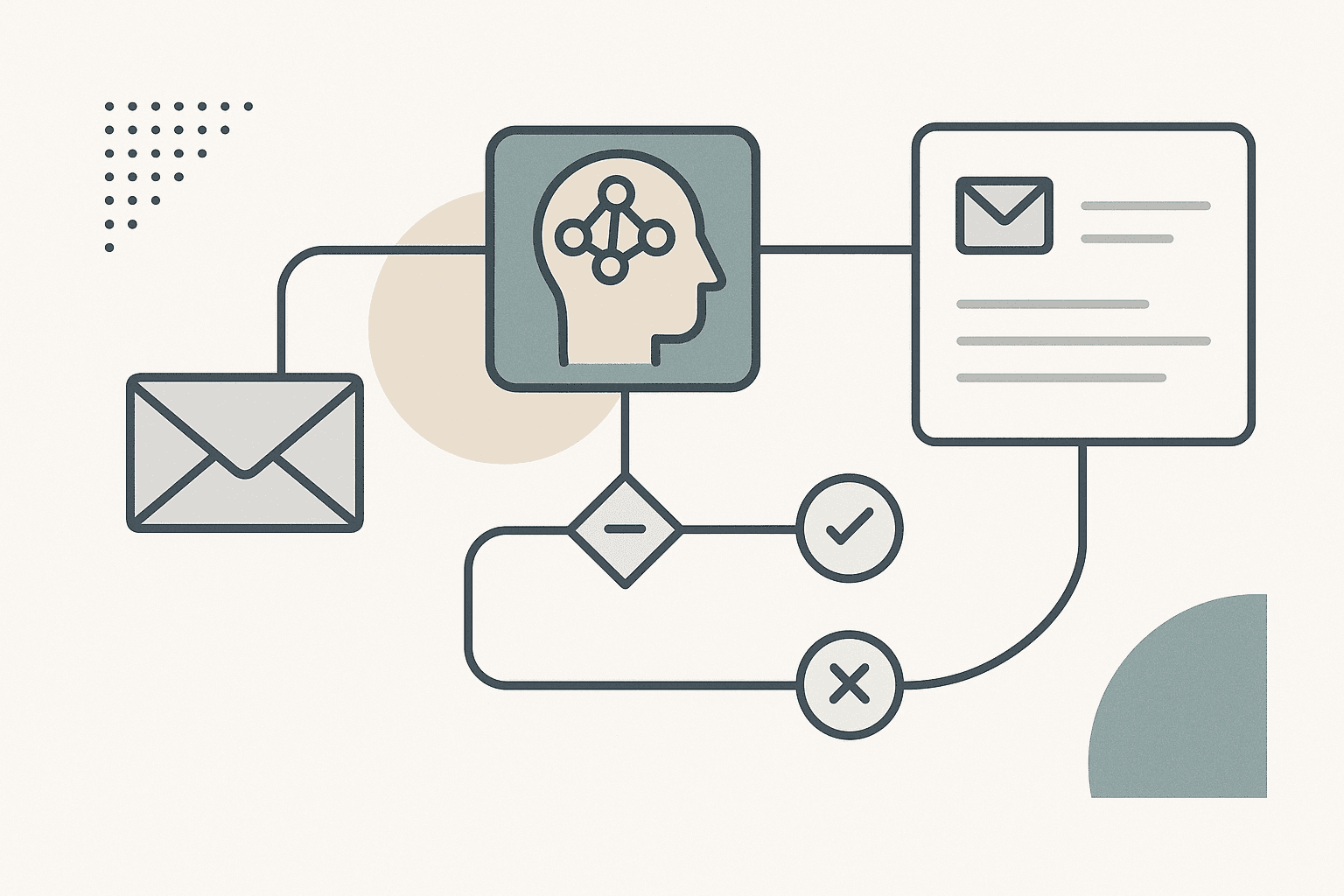
Are your AI-driven email workflows generating duplicate actions from forwarded requests? This common issue can lead to operational inefficiencies and customer dissatisfaction. By the end of this article, you'll know how to ensure that forwarded requests are correctly interpreted and processed as a single action by your AI systems.
Understanding the Problem of Duplicate Requests
In AI email workflows, the potential for processing duplicate requests is high, especially when emails are forwarded or replied to with quoted text. For instance, if a customer emails to change their delivery address, and an employee forwards this request to the operations team, the AI might read both the original and forwarded emails as separate requests. This leads to multiple actions being taken for a single customer request.
The key issue here is that AI systems can misinterpret context. They are excellent at extracting data but may lack the nuance to understand that a forwarded email is not a new request. This can result in redundant processes, such as sending multiple confirmation emails or executing the same change several times, causing unnecessary workload and potential errors.
Why AI Misinterprets Forwarded Emails
AI systems rely heavily on keywords and patterns to extract information. While this is effective for identifying requests, it can also lead to errors when the same request appears in multiple contexts. For example, an AI might detect the phrase "change my delivery address" in both the original and forwarded emails, treating each as a separate task.
The challenge is compounded when the customer replies with a "thanks" email that includes the original message. The AI sees the quoted text and may again interpret it as a new request. This happens because most AI systems lack the natural language understanding required to discern the context of quoted or forwarded content.
Implementing Contextual Filters
To prevent duplicate actions, it's crucial to implement contextual filters in your AI workflows. These filters can help the AI differentiate between original requests and forwarded or quoted content. By identifying patterns such as "FW:" or "RE:" in email subjects or checking for quoted text markers, the system can be trained to recognize when a request is being forwarded or replied to.
Additionally, setting up rules that flag emails containing quoted text can further refine the workflow. These rules can prompt a manual review or trigger a secondary analysis by the AI, ensuring that only unique requests are processed. This approach reduces the likelihood of duplicates and maintains the efficiency of the workflow.
Leveraging Machine Learning for Improved Context Understanding
Machine learning models can be trained to better understand the context of emails. By feeding the AI a diverse set of examples, including forwarded and replied emails, you can enhance its ability to discern whether a message is a new request or a continuation of an existing conversation.
These models can learn to recognize patterns that indicate a reply or forward, such as email headers or repeated phrases. Over time, the AI becomes more adept at filtering out non-unique requests, improving accuracy and reducing the need for manual intervention. This not only streamlines operations but also enhances customer satisfaction by minimizing errors.
Monitoring and Iterating on Your Workflow
Once you've implemented these solutions, it's important to continuously monitor the effectiveness of your AI workflows. Regularly reviewing the system's performance can help identify areas for improvement and ensure that the AI is correctly interpreting emails.
Use analytics tools to track metrics such as the number of duplicate actions, response times, and customer feedback. This data can inform further refinements to your workflow, keeping it aligned with your operational goals. Remember, AI workflows are not set-and-forget solutions; they require ongoing adjustment to adapt to new challenges and maintain efficiency.
What To Do Next
This week, audit your existing AI email workflows to identify potential sources of duplicate actions. Implement contextual filters and consider training machine learning models to improve context understanding.
WhatsApp Mohamed at **+201069052620** (public business line) if you need to discuss customizing AI workflows to eliminate duplicate actions and enhance operational efficiency.