Custom AI Assistant Integration
A ChatGPT trained on YOUR business, embedded where your customers already are.
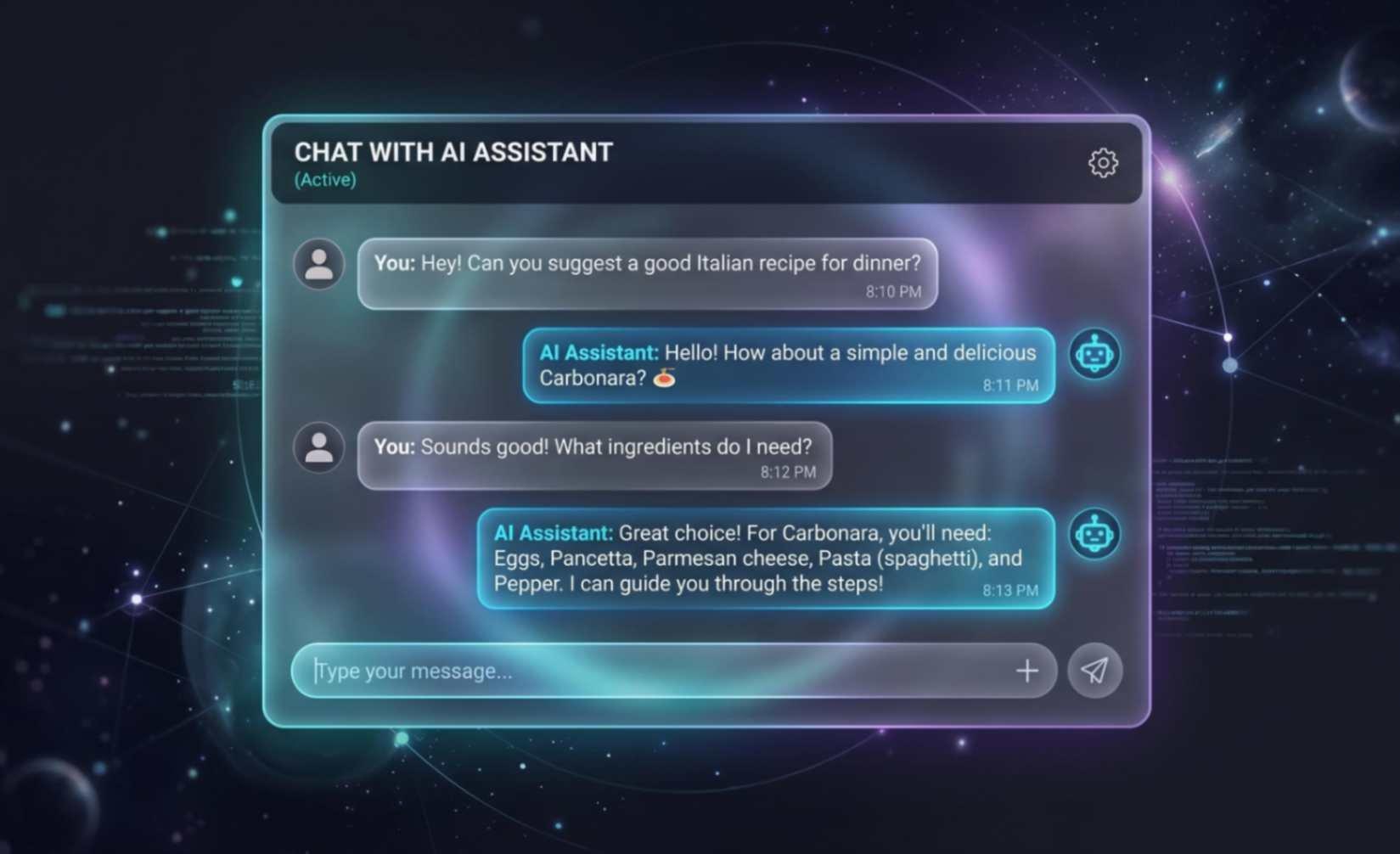
A domain-trained AI assistant deployed on your website, Slack, WhatsApp, or internal app, answering real questions with your real data.
- Trained on your docs, policies, or product knowledge
- Embedded in the channel your users already use
- You own the integration and the source code
Best For
- Support-heavy business burning hours on repeat questions
- E-commerce or SaaS wanting in-product AI help
- Teams with a substantial internal knowledge base
- Founders who want a tangible AI moat without an in-house ML team
Not Ideal For
- You expect a flawless human-level assistant on day one
- You won't or can't provide source content/docs
- Hallucination risk in regulated contexts you can't tolerate
- Budget under $2,000
Outcomes You Can Expect
Tangible results from a focused engagement
Faster customer answers
Faster customer answers
Reduced support load
Deflect 30–60% of repeat questions from your team
Always-on domain expertise
Embedded where your users already are
How We Work Together
A clear path from discovery to delivery
- 1Day 0–2
Discovery & Content Audit
Review your knowledge base, define use cases
- 2Day 3–7
RAG Pipeline Build
Ingestion, vector store, retrieval logic
- 3Day 8–10
Assistant Layer
Prompt engineering, guardrails, eval harness
- 4Day 11–12
Channel Integration
Embed in website / Slack / WhatsApp / app
- 5Day 13–14
Launch & Tuning
Soft launch, monitor, tune
What's Included
Everything in scope for a typical engagement
RAG pipeline (ingestion + vector store + retrieval)
Custom prompt engineering
Guardrails and safety filters
One channel integration (web widget, Slack, WhatsApp, or in-app)
Evaluation harness for response quality
Admin dashboard to view conversations
2 weeks of post-launch tuning
Full source code
Documentation and handover Loom
Tools & Stack
Engagement at a Glance
Starting at
$2,000
Additional channels (Slack + WhatsApp + website) scope upward. Final quote on discovery.
- Timeline
- 10–14 days
- Scope
- 1 channel, 1 knowledge domain
- Support
- 2 weeks tuning + 60-day bug fix
- Ownership
- Full source code & infrastructure
Featured Work
A representative engagement pattern and the outcomes it targets
An AI assistant trained on this site's content. Live on every page, answering visitor questions in seconds with citations.
Results at a Glance
- RAG-trained on every page of this site
- Site-wide
- Average response time
- < 2s
- Includes source citations
- Every answer
To demonstrate what a Custom AI Assistant Integration delivers, I built and embedded one on AutoMagicDeveloper.com itself. The assistant ingests every service page, blog post, and FAQ on this site through a RAG (retrieval-augmented generation) pipeline, retrieves the most relevant context for each visitor question, and answers in natural language with citations linking back to the source pages. The widget you see in the bottom-right corner of every page is the same product I'd build for you, only trained on your content instead of mine.
Ready to scope something similar?
Share your context and goals. We can map a path from discovery to delivery for this service.
Deep Dive
Scope, approach, and technical detail for this service
What "trained on your data" actually means
When someone says they want a "ChatGPT for our business," they usually mean one of three different things — and the difference matters enormously for cost, risk, and outcome.
| Approach | What it means | When it's right |
|---|---|---|
| Fine-tuned model | Adjusting a base model's weights using your data | Specialized writing style or jargon at high volume; rarely the right answer for business knowledge |
| Prompt-engineered assistant | A standard model with your content stuffed into the system prompt | Tiny knowledge bases; fragile as content grows |
| RAG (Retrieval-Augmented Generation) | Your content lives in a vector database; relevant chunks are retrieved and given to the model per query | The right answer for ~95% of business AI assistant use cases |
Custom AI Assistant Integration is almost always the third option — RAG. It's the right architecture for nearly every "AI assistant trained on my business" use case, because:
- Your content updates anytime, without re-training
- The model cites its sources, so users can verify
- Hallucination is dramatically lower because answers are grounded in your actual content
- Your data is not used to train the LLM provider's models
- Costs scale predictably with usage, not with content volume
The architecture of a Custom AI Assistant
A production-grade Custom AI Assistant has five components:
1. Ingestion pipeline
Your content sources — documentation, knowledge base articles, FAQs, policy PDFs, product specs, support tickets — are pulled, cleaned, chunked into semantic units, and embedded as high-dimensional vectors. This pipeline runs whenever your content updates, so the assistant always reflects current truth.
2. Vector store
A specialized database that stores the embedded chunks and returns the most semantically relevant ones for any query in milliseconds. Common choices: pgvector (Postgres extension, self-hosted), Pinecone (managed), Qdrant, Weaviate. The right pick depends on your scale, your hosting preferences, and your data privacy requirements.
3. Retrieval logic
When a user asks a question, the query is embedded, the most relevant chunks are pulled from the vector store, and they're ranked. Smart retrieval is what separates a good Custom AI Assistant from a frustrating one — naive retrieval pulls plausible-but-wrong context, which leads to plausible-but-wrong answers.
4. Assistant layer
The retrieved context is passed to the LLM (OpenAI, Claude, or whichever fits your privacy and quality needs) along with a carefully engineered system prompt that defines the assistant's tone, scope, guardrails, and behavior when it doesn't know.
5. Channel integration
The assistant is exposed where your users already are: a web widget on your site, a Slack bot, a WhatsApp Business number, an in-product chat. One channel is included in the standard Custom AI Assistant Integration engagement; additional channels scope upward.
Guardrails that production assistants need
A serious Custom AI Assistant doesn't just generate text. It has:
- Scope guardrails — instructions that keep the assistant from answering off-topic or out-of-policy questions
- Uncertainty marking — when retrieval confidence is low, the assistant says "I don't have a confident answer for this" rather than fabricating
- Source citations — every answer references the page or document it pulled from, so users can verify
- PII handling — if you have user-data privacy requirements, the assistant is configured to refuse or redact accordingly
- Eval harness — a small test suite of representative questions with expected answers, so quality doesn't regress when the underlying model or retrieval changes
These aren't optional in a production Custom AI Assistant. They're the difference between an assistant your team trusts and one your team has to babysit.
Where your Custom AI Assistant lives — channel options
The standard Custom AI Assistant Integration engagement covers one channel. The most common:
- Website widget — a floating chat bubble or full-page chat embedded on your marketing site, documentation, or app
- Slack integration — a bot answering inside your team's Slack workspace, often used for internal employee assistants
- WhatsApp Business — a number your customers can message directly; common for support and sales in MENA and emerging markets
- In-product chat — embedded inside your existing SaaS or app, often for in-product help and onboarding
Additional channels can be added as scope grows. The retrieval and assistant layers are shared across channels; only the channel-specific integration code differs.
Data privacy: where things actually live
This question comes up on every discovery call. Plain-English answers:
Will my data be used to train OpenAI's or Anthropic's models? No, not when used through their business API tiers under standard terms.
Where is my content stored? Your choice. Two common paths:
- Self-hosted — your content lives in a vector store on your infrastructure. Nothing leaves your environment except per-query API calls to the LLM provider.
- Managed — your content lives in a managed vector service like Pinecone. Faster to set up, simpler to operate, but your content sits with a third-party provider under their terms.
We pick the right path together during discovery, based on your privacy posture and what your data actually contains.
What it costs to run a Custom AI Assistant after launch
Two cost components, both predictable:
- LLM API costs — these scale with usage (number of conversations and tokens per conversation). Typical SMB traffic ranges from $50 to $300 per month. High-volume use cases scale linearly; we estimate this on the discovery call from your expected traffic.
- Infrastructure costs — vector store, small backend, hosting. Typically $20 to $100 per month for SMB scale. Lower if self-hosted on infrastructure you already pay for.
The total monthly cost for a typical SMB Custom AI Assistant is in the $80 to $400 range. There are no per-conversation hidden fees from the integration itself.
When Custom AI Assistant Integration is the wrong product
- You expect a flawless human-level support agent on day one. Even the best RAG assistants need a few weeks of tuning before they handle the long tail well. Plan for the tuning window.
- You can't or won't share source content. The R in RAG isn't optional.
- You're in a heavily regulated space and any hallucination is catastrophic. RAG dramatically reduces hallucination but doesn't eliminate it. Plan for human-in-the-loop review.
- Your "knowledge base" is people's heads, not documents. That's an Audit problem first.
The standard engagement, in one paragraph
Two weeks. One channel. One knowledge domain. Full source code, full ownership, two weeks of post-launch tuning, and a 60-day bug-fix window. Quoted from $2,000 on the discovery call, with additional channels and domains scoped on top. The Custom AI Assistant you build with me is yours forever — including the right to swap LLM providers, host on different infrastructure, or extend it without me.
Quick answers to the questions every buyer asks
Is RAG the same as fine-tuning? No. RAG keeps the model generic and feeds it your content per query. Fine-tuning permanently changes the model's weights. RAG is almost always the better fit for business knowledge assistants.
Will the assistant work in Arabic? Yes — modern LLMs handle Arabic well. We can configure the assistant for Arabic-only, English-only, or bilingual responses.
Can I see one of your assistants live? Yes — the chat widget on this site is itself a Custom AI Assistant Integration trained on this site's content. Try asking it about a service.
Ready to give your business its own AI assistant?
Book a free 20-minute Discovery Call to scope the right Custom AI Assistant Integration for your situation, or send a brief about your project and I'll respond within 24 hours.
Frequently Asked Questions
Ready to get started?
Send a brief about your goals and context. I reply within 24 hours with clear next steps.